
Walk past a Corradi pergola in Milan's Brera district and you might not notice the label. That's the point. The company has spent seven decades perfecting outdoor structures that blend into their surroundings—until you look closer. A retractable awning glides open without a sound;a bioclimatic pergola tilts its blades to track the sun. These aren't off-the-shelf products. Each one starts as raw aluminum in a factory near Bologna, gets cut, welded, and powder-coated。then ships to a private terrace in Tokyo or a hotel pool in Dubai.Corradi's story begins in 1954, when a small workshop in the Emilia-Romagna region began crafting metal canopies for local homes. The founder。whose name still anchors the brand, had a simple obsession: make outdoor living feel as effortless as indoor living. That meant solving problems most manufacturers ignored—wind resistance, water drainage, UV fading. By the 1980s, Corradi had patented a folding arm mechanism that became a quiet standard in the industry. I've seen a 30-year-old Corradi awning still operating on a lakeside villa in Como;the fabric was replaced twice, the frame never touched.What sets Corradi apart isn't flashy marketing. It's the engineering tolerance. Their bioclimatic pergolas use a system of adjustable louvers that can be set from 0 to 135 degrees, allowing precise light control without blocking airflow. The aluminum profiles are extruded in-house, which means they can tweak wall thickness by fractions of a millimeter to balance weight and rigidity. A competitor might outsource that step;Corradi keeps it under one roof. That vertical integration explains why a Corradi structure often costs 20–30% more than a comparable import—and why architects specify it anyway. On a rooftop in Singapore, I watched a Corradi unit handle monsoon rain without a single drip through the joints. The installer shrugged: 'We just follow the manual.'
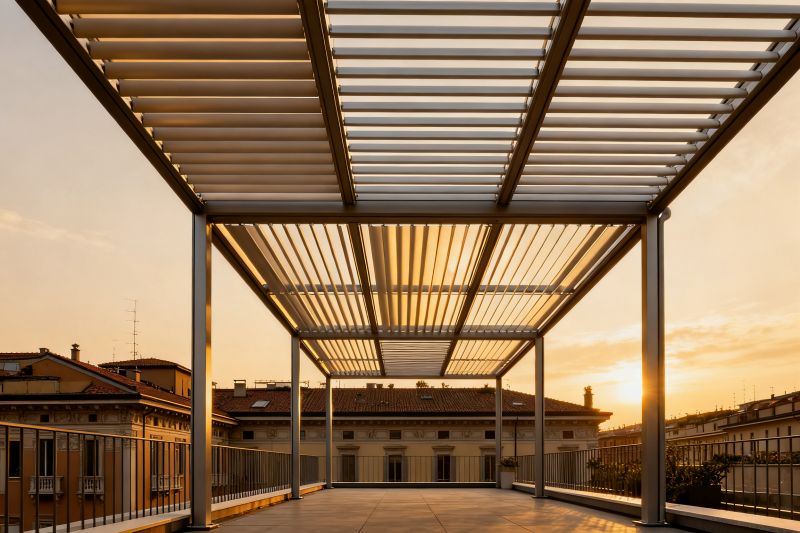
The company's reach extends beyond private homes. Corradi has supplied shading systems for restaurants along the French Riviera, modular pergolas for a co-working campus in Berlin, and custom canopies for a hospital courtyard in Melbourne. Each project demands something different—salt-air corrosion resistance, snow-load ratings。acoustic dampening. Corradi's engineers keep a library of thousands of CAD files, but they also prototype fast. A recent collaboration with a Venetian hotel required curved beams that followed the building's Gothic arches. The solution involved a new bending jig built in three weeks. That kind of responsiveness is rare in a company this size, and it's why Corradi rarely loses a repeat client.
Does Corradi have weaknesses?Sure. Lead times can stretch to 12 weeks for custom colors。and the premium pricing puts it out of reach for budget-conscious buyers. But for those who value longevity over sticker price, the math works. A Corradi pergola installed in 2005 still adds resale value to a property today. The brand doesn't chase trends—it waits for the market to catch up. In an industry crowded with lookalikes, Corradi remains the reference point, quietly shaping how we use outdoor space without shouting about it.